Parallel circuit with meters
Learn with an AI tutor
An AI tutor explains this page to you and helps you with the exercises. Choose your assistant:
Open with Claude Open with ChatGPT Open with Mistral Vibe
You use your own account with the provider. The assistant is not offered by lernapps.net: lernapps only provides the content and the exercises. The choice holds for all pages, on this device only.
The idea
Two resistors sit side by side on a battery, each in a branch of its own. You measure the current in the main wire and in one branch. The current splits at the junction, and both branches have the full voltage. You already know how a parallel circuit is built.
What to remember
In a parallel circuit: - Every branch has the same voltage: . - The branch currents add up to the current in the main wire: . - Each branch current is and . - The total resistance is smaller than each single resistance, because the current has more paths.
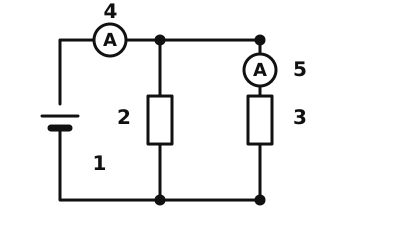
Two resistors in parallel. Ammeter 4 measures the total current, ammeter 5 only the current in the right branch. Labels: 1 battery, 2 and 3 resistors, 4 ammeter in the main wire, 5 ammeter in the branch.
Source: https://github.com/lernapps/elektrizitaet. Licence: CC0-1.0.The smaller resistor draws more current
Because every branch has the same voltage, the larger current flows in the branch with the smaller resistance.
Example
Two branches on 12 V
A resistor of 20 Ω and one of 30 Ω are connected in parallel on 12 V. Branch 1: A. Branch 2: A. The ammeter in the main wire shows A.
Practice
Task no. 1
Task no. 1
Two resistors of 10 Ω and 30 Ω are connected in parallel on 9 V. What does the ammeter show in the branch with the second resistor (30 Ω)?
The circuit is switched off. Predict the number, then switch on: the ammeter sits in the branch with the second resistor.
Solution
The second branch is across 9 V: 9 V : 30 Ω = 0.3 A. The first resistor changes nothing about it.
Exercise
Three worked tasks, each with its solution:
Task no. 1
Two resistors of 10 Ω and 30 Ω are connected in parallel on 6 V. What is the current in the main wire in amperes?
Hint
First calculate each branch current, then add.
Solution
- ,
Right answer: 0.8 A
Task no. 2
Two resistors of 30 Ω and 10 Ω are connected in parallel on 12 V. What is the current in the main wire in amperes?
Hint
First calculate each branch current, then add.
Solution
- ,
Right answer: 1.6 A
Task no. 3
Two resistors of 10 Ω and 60 Ω are connected in parallel on 12 V. What is the current in the main wire in amperes?
Hint
First calculate each branch current, then add.
Solution
- ,
Right answer: 1.4 A
Exercise
Three worked tasks, each with its solution:
Task no. 1
In the main wire of a parallel circuit 0.6 A flows. In the first branch the ammeter shows 0.4 A. What is the current in the second branch in amperes?
Hint
, so .
Solution
Right answer: 0.2 A
Task no. 2
In the main wire of a parallel circuit 0.8 A flows. In the first branch the ammeter shows 0.3 A. What is the current in the second branch in amperes?
Hint
, so .
Solution
Right answer: 0.5 A
Task no. 3
In the main wire of a parallel circuit 1 A flows. In the first branch the ammeter shows 0.4 A. What is the current in the second branch in amperes?
Hint
, so .
Solution
Right answer: 0.6 A
Exercise
Solution
6 V right answer
In a parallel circuit every branch has the full voltage of the source.
3 V
The voltage is only shared in a series circuit. Not in a parallel circuit.
12 V
The voltages do not add up. Both branches are across the same 6 V.
In a parallel circuit the voltage is the same across all branches.
More on it: