Series circuit
Learn with an AI tutor
An AI tutor explains this page to you and helps you with the exercises. Choose your assistant:
Open with Claude Open with ChatGPT Open with Mistral Vibe
You use your own account with the provider. The assistant is not offered by lernapps.net: lernapps only provides the content and the exercises. The choice holds for all pages, on this device only.
The idea
You can connect two lamps to a battery in two ways. The first way is called a series circuit: the lamps hang one behind the other like beads on a string.
What to remember
- Series circuit
In a series circuit the parts are connected one behind the other. There is only one path for the current.
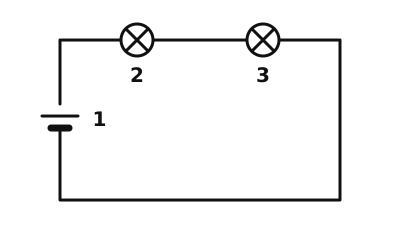
The current has to pass through both lamps, one after the other. There is no other path. Labels: 1 battery, 2 lamp 1, 3 lamp 2.
Source: https://github.com/lernapps/elektrizitaet. Licence: CC0-1.0.It follows that:
- If one lamp is broken or unscrewed, the circuit is broken and all lamps go out.
- A switch in the series switches all lamps on and off together.
- The more lamps you connect in series, the dimmer they shine.
Example
The old string of lights
In some older strings of lights all the little bulbs are connected in series. If you unscrew one bulb, the whole string goes out. Then you look for the broken bulb until the string lights up again.
Practice
Exercise
Solution
Right answer: The statement is false.
In a series circuit there is only one path for the current. If a lamp is missing, the circuit is open and the other goes out too.
More on it:
Exercise
Solution
Exactly one. right answer
The parts hang one behind the other, so the current has only one way around the circuit.
One for each lamp.
Separate paths for each lamp exist in a parallel circuit, not in a series circuit.
None; the lamps shine because of the battery.
Without a path for the current no lamp shines. The circuit must be closed.
In a series circuit there is only one path, on which the current flows through all parts one after the other.
More on it:
Exercise
Solution
Right answer: The statement is true.
The current runs through all parts one after the other. It does not matter where the switch sits: when you open it, the circuit is broken and all lamps go out.
More on it:
Task no. 1
Task no. 1
Build a circuit with two lamps one behind the other, that is, in series. When you unscrew one lamp, the other should go out too.
The circuit board is a circuit with two places. You choose lamp, switch or wire, tap a place and then switch the power on.
Solution
A lamp on each of the two places, a switch is allowed. If you unscrew one, the other goes out.